

 Australia
 USA
USA Canada
 Ireland




Most businesses that miss VAT deadlines know what a VAT return is. The problem is rarely knowledge — it is workflow.
HMRC’s shift to a digital-first compliance environment has changed the stakes considerably. Under Making Tax Digital, every submission leaves a traceable data footprint. Automated systems flag inconsistencies in real time. Penalty points accumulate quietly. And by the time a business or accounting firm realises there is a problem, the compounding has already begun.
VAT compliance is no longer an administrative overhead on the periphery of a finance function. It is an operational discipline — one where delays, misclassifications, and broken digital links are detected faster than ever before.
This guide covers what UK businesses and accounting firms need to know for 2026: the precise deadlines, how HMRC’s penalty system actually works, the most common errors that trigger investigations, and the operational framework that separates firms that file confidently from those that fire-fight every quarter.
What Is a VAT Return?
A VAT return is a periodic declaration submitted to HMRC that reports the difference between the VAT a business has charged on its sales (output VAT) and the VAT it has paid on its purchases (input VAT).
If output VAT exceeds input VAT, the business pays the difference to HMRC. If input VAT exceeds output VAT — common in businesses with high capital expenditure or export-heavy operations — HMRC issues a refund.
The calculation sounds straightforward. In practice, it is a detailed reconciliation across every transaction within a given period, each of which must carry the correct VAT treatment — standard rate (20%), reduced rate (5%), zero rate, or exempt.
HMRC does not treat VAT returns merely as payment instruments. They are compliance records used to assess the accuracy of a business’s transactional reporting, its VAT scheme eligibility, and its adherence to Making Tax Digital requirements. A pattern of errors — even corrected ones — can trigger a compliance check.
VAT returns are not merely tax forms — they are compliance records that HMRC uses to assess transactional accuracy and business reporting behaviour.
Who Must Submit VAT Returns in the UK?
Any business with a taxable turnover exceeding £90,000 in a rolling 12-month period must register for VAT and submit returns to HMRC. This threshold applies as of 2026.
Voluntary registration is also available below the threshold — and often advisable for businesses that regularly reclaim input VAT or supply other VAT-registered businesses.
The duty applies to all types of business organisations, such as an LLP, a partnership, a limited company, and a sole trader. No businesses are exempt from VAT simply because they are in a particular sector. Here are some of the most frequent registrations:
- e-commerce sellers (including marketplace traders on Amazon, eBay, and Etsy)
- Construction contractors and subcontractors (including those under the Domestic Reverse Charge)
- Hospitality businesses
- Consultants and professional services firms
- Recruitment and staffing agencies
- Import/export businesses
- Property businesses with opt-to-tax premises
Businesses Most Frequently Investigated for VAT Errors
HMRC’s compliance activity is not random. Certain sectors attract disproportionate scrutiny:
- Cash-intensive businesses — restaurants, market traders, taxi firms — where underreporting of output VAT is a known risk pattern.
- Construction — the Domestic Reverse Charge introduced in 2021 continues to be misapplied, with subcontractors incorrectly charging VAT and contractors failing to account for it correctly.
- Hospitality — multi-rate VAT treatment (food vs alcohol, hot vs cold food, dine-in vs takeaway) creates classification errors that compound over time.
- eCommerce — overseas sellers, fulfilment warehouses, digital services, and marketplace VAT obligations create layered complexity that many businesses handle incorrectly.
- Multi-rate businesses — any business supplying a mix of standard-rated, zero-rated, and exempt goods or services must apply partial exemption rules, which are among the most frequently misunderstood areas of UK VAT.
UK VAT Return Deadlines Explained
Quarterly VAT Returns
The usual filing timeline for businesses in the UK. The repayment and return must be made 1 calendar month and 7 days after the end of the VAT accounting period.
VAT quarters are normally at the end of March, June, September, or December (although companies with a different VAT year may have other months).
Monthly VAT Returns
For businesses that reclaim VAT regularly (generally businesses that export, or have substantial capital investment, or are in a continuous repayment position). As with all months, seven days after the end of every month and one month after the end of every month. There are 12 monthly deadlines per year with the same compliance weight.
Annual Accounting Scheme
Designed to ease administrative burden for smaller businesses (with taxable turnover of less than £1.35 million). In Annual Accounting scheme, businesses submit one annual VAT return two months after the end of the year, but make advance payments throughout the year, either as nine monthly estimates or as three quarterly instalments. If the instalment schedule is not adhered to, interest may be charged on late payments.
Flat Rate Scheme Filing Rules
The Flat Rate Scheme allows companies to pay a percentage of their total turnover to HMRC instead of working out output and input VAT. The filing will continue to be quarterly (or monthly), and the same one-month-plus-seven-day period applies. However, because input VAT is not usually recoverable under the scheme (unless it relates to capital goods of more than £2,000), the recon process also varies, and businesses frequently apply the wrong flat-rate percentage for their sector.
VAT Payment Deadline vs Filing Deadline
These are the same date – but not the same event.
Filing is when you have submitted your VAT return to HMRC, and it has been accepted and recognised using MTD-compatible software. Payment is when the funds have been paid into HMRC’s account. If a return is filed on time and a payment is made that will clear 1 day late, it will still be considered a late payment.
The difference is important because different payment methods have different settlement time-scales, and HMRC’s penalty regime doesn’t differentiate between late payment and late filing.
2026 UK VAT Return Calendar
The table below covers all four standard quarterly deadlines for the 2026 tax year. These apply to businesses on standard quarterly returns. Deadlines falling on weekends or bank holidays are moved to the next working day — always verify with HMRC’s published schedule.
VAT Quarter End | Filing Deadline | Payment Deadline |
31-Mar-26 | 07-May-26 | 07-May-26 |
30-Jun-26 | 07-Aug-26 | 07-Aug-26 |
30-Sep-26 | 07-Nov-26 | 07-Nov-26 |
31-Dec-26 | 07-Feb-27 | 07-Feb-27 |
Practical Timing Considerations
Weekends and bank holidays: If 7 May falls on a weekend, the deadline will be moved to the next working day. HMRC confirms these adjustments on its website — always check rather than assume.
Faster Payments: Generally, same-day or next-day, but batch processing cut-off times vary by bank. Initiating a payment at 4:45 pm on deadline day is a risk.
CHAPS and BACS: CHAPS is same-day if submitted before your bank’s cut-off (typically 2 pm). BACS takes three working days — never use it for deadline-day payments.
Direct Debit: HMRC collects payment automatically three working days after the filing deadline — not on the deadline itself. This grace is built in, but the Direct Debit must be set up in advance, and the return must be filed on time for the collection to be triggered.
HMRC Late VAT Return Penalties in 2026
How the VAT Penalty Points System Works
HMRC replaced the old default surcharge regime in January 2023 with a points-based system for late submissions. The logic is designed to distinguish habitual non-compliance from an isolated missed deadline.
Each missed VAT return filing earns one penalty point. Points accumulate on a rolling basis:
Filing Frequency | Penalty Threshold | Financial Penalty |
Quarterly | 4 points | £200 |
Monthly | 5 points | £200 |
Annual | 2 points | £200 |
Once the threshold is reached, HMRC issues a £200 financial penalty. Every subsequent missed return while above the threshold triggers a further £200. Points expire after 24 months of clean compliance — meaning all returns filed on time. Reaching the threshold resets that clock.
The practical implication: a business that misses four consecutive quarterly returns faces not just four penalty points and one £200 fine, but ongoing £200 penalties for each further miss — plus late payment penalties running concurrently.
Late VAT Payment Penalties
Late payment penalties operate on a separate, time-based structure:
- Days 1–15: No financial penalty, but HMRC’s late payment interest begins accruing immediately at the Bank of England base rate plus 2.5%.
- Day 16: A first penalty of 2% of the outstanding VAT is charged on the amount unpaid as of day 15.
- Day 31: A second penalty of 2% of the outstanding VAT is added to the amount still unpaid as of day 30.
- Day 31 onwards: An additional daily penalty accrues at 4% per annum on the outstanding balance until the debt is cleared.
The compounding effect is frequently underestimated. Businesses that manage a cash-flow shortfall by delaying VAT payments often calculate a rough one-off penalty and stop there. The interest accruing from day one, combined with the day 16 and day 31 charges, plus the ongoing daily rate, results in a materially higher total.
Real-World Example of a Late VAT Filing
A retail business with a March 2026 quarter-end owes £12,000 in VAT, due 7 May 2026.
A cash flow issue delays payment. The business pays on 27 May — 20 days after the deadline.
The penalty calculation:
- Late payment interest (days 1–20): £12,000 × (BoE base rate + 2.5%) × 20/365 — approximately £70–£90 at current rates.
- Day 16 penalty: £12,000 × 2% = £240
- Total additional cost: approximately £310–£330 — on a bill that was simply paid 20 days late.
If the return itself was also filed late and this is the business’s fourth missed deadline in 12 months, add a £200 penalty point fine. If HMRC follows up and payment remains outstanding beyond day 31, the daily rate applies to the full outstanding balance.
The numbers are not catastrophic for a single incident. But the pattern — particularly for accounting firms managing multiple clients — is what creates systemic exposure.
Most Common VAT Filing Mistakes UK Businesses Make
The businesses and firms that face HMRC scrutiny rarely do so because of deliberate evasion. Most compliance failures are structural — systems, processes, or knowledge gaps that repeat across periods.
Duplicate invoices: Purchase invoices are double-processed, either over different periods or during the same period, resulting in an overestimation of the input VAT claim. This can be caught by reconciling against bank statements; it will multiply.
Wrong VAT rates: One of the most common mistakes is applying the wrong VAT rate to supplies that should be at 5% or 0% or vice versa (standard-rated supplies as exempt). The lower rate for domestic energy and for some building services is often used.
Reclaiming blocked input VAT: Under UK VAT law, blocked input VAT includes VAT on business entertainment, cars (unless used solely for business) and some client hospitality. Many businesses want to recover it anyway.
Missing import VAT: Since Brexit, import VAT accounting has changed significantly. Post-Brexit import VAT is claimed in the VAT system via Postponed VAT Accounting (PVA) and is not set up in bookkeeping systems without it being claimed — it must be activated via the PVA statement, which is sent monthly.
Poor period-end reconciliation: When a return is filed without reconciling the VAT control account with the bank and source documents, errors are recorded and will not be identified until an investigation is conducted.
Excel-only bookkeeping: Without MTD-compatible bridging software, spreadsheets are not bookkeeping — only an Excel-based system meets the requirements of Making Tax Digital. Penalties can be imposed not only for errors in returns, but also for poor record-keeping.
Missing digital links under MTD: MTD requires data to be transferred between software systems without manual rekeying. Copying VAT figures from a spreadsheet into a separate accounting package by hand is a broken digital link — a specific compliance failure.
Incorrect treatment of exempt supplies: When businesses provide both exempt and taxable supplies, they need to follow the partial exemption rules to calculate what proportion of their input VAT is recoverable. Many just claim a refund on all VAT paid in as input.
Reverse charge VAT confusion: Domestic reverse charge is a VAT regime in which the customer is responsible for paying VAT when the supplier is liable for it, and there are reverse charge rules for certain imported construction services. Underreporting or overclaiming is considered misapplication, which HMRC will pick up on.
EC transaction reporting: Despite the UK’s exit from the EU single market, several transaction types affecting Northern Ireland and cross-border B2B supplies have specific reporting obligations that are often overlooked.
How to Submit VAT Returns Correctly: A Step-by-Step Framework
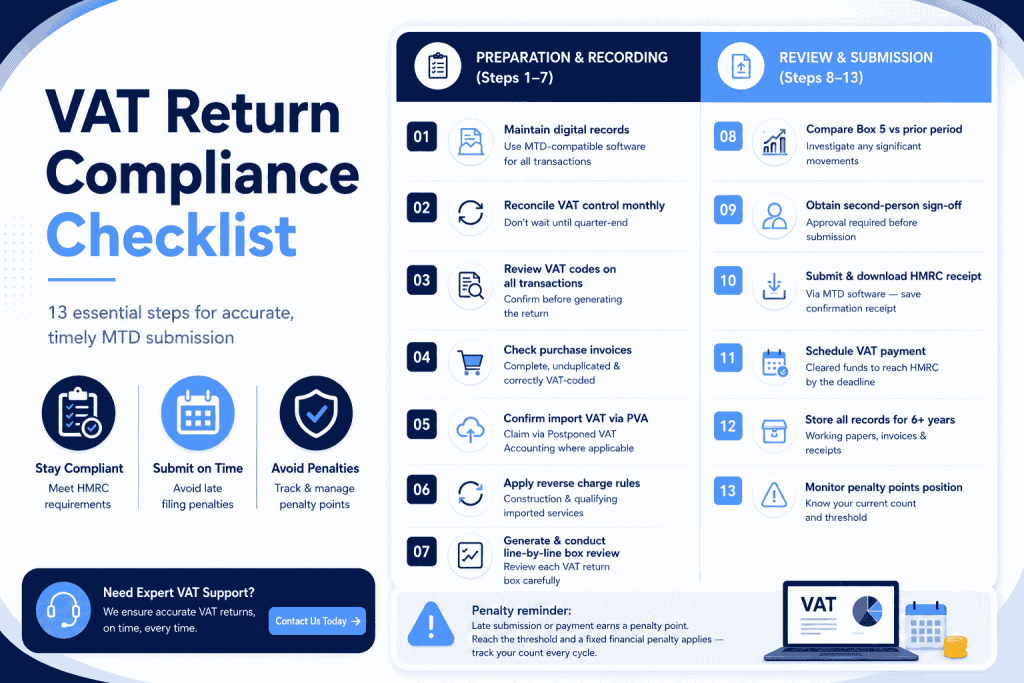
Step 1: Organise Digital Financial Records
Make sure all financial records are completed and received electronically before any calculation is made. Under MTD, this means that all transactions should be captured by software, such as sales invoices, purchase invoices, bank feeds and credit notes, and that the correct VAT codes should be applied at source. Incomplete records at this stage cause errors at every subsequent step.
Step 2: Reconcile Sales and Purchase Data
Compare the VAT control account in your bookkeeping software with transactions from your bank statement and source documents. Detect duplicate entries, missing invoices, and transactions incorrectly VAT-treated. No return is compliant if it is not submitted with reconciliation — it is an estimate.
Step 3: Review VAT Codes Carefully
Before generating the return, check the VAT codes for transactions in the period. Particular attention should be paid to the following: any supplier or customer who has recently joined your service; import/export transactions; construction subcontractor invoices (reverse charge applicability); and any transactions between different VAT rate categories.
Step 4: Generate VAT Return Through MTD Software
Use MTD-compatible software — Xero, QuickBooks, Sage, FreeAgent, or equivalent — to generate the VAT return. Review each box:
- Box 1: Output VAT on sales and other outputs
- Box 2: VAT on acquisitions from EC member states (where applicable)
- Box 4: Input VAT on purchases
- Box 5: Net VAT payable or reclaimable
- Box 6 and 7: Total sales and purchases excluding VAT — cross-check these for obvious mismatches against your actual turnover for the period
Step 5: Conduct Internal Review Before Submission
The return shall not be made without a second review by the preparer. The review should compare Box 5 with the previous period, identify any unusual activity, and verify that the digital trace from the source documents to the return is intact. A well-designed review template helps prevent the review from being superficial if a firm has more than one client.
Step 6: Submit Directly to HMRC
Connect to HMRC’s MTD portal through the software and submit. Always download and keep the HMRC confirmation receipt. The software’s acknowledgement of the submission is not the only proof; the HMRC acknowledgement should be used.
Step 7: Retain VAT Records for 6 Years
VAT records must be kept for at least 6 years by HMRC. This means that all sales and purchase invoices, VAT calculations, submission receipts, and bank statements for the specific time periods are included. Cloud-based storage, like Dext, Hubdoc or the document management function in your accounting software, makes it easy to retrieve, not just possible.
Making Tax Digital (MTD) and VAT Compliance
MTD for VAT is not a voluntary framework. VAT-registered businesses with all VAT returns submitted electronically from April 2022 have been required to keep digital records and to file VAT returns via MTD-compatible software. Digitalisation of all VAT returns was introduced in April 2022 for all VAT-registered businesses, including those registered below the VAT threshold.
The core requirements are:
- Digital records: All transactions must be recorded digitally, and sufficient data must be provided to enable the VAT return to be recreated. Description, VAT amount and gross value should all be captured in the record along with the time of supply.
- Digital links: These are essential for transmitting data from one system to another, whether between a point-of-sale system and accounting software or from a spreadsheet to a VAT return; the data needs to be transmitted in a digital, uninterrupted format. Manual transcription is a non-compliance.
- Compatible software: HMRC has a list of MTD software available on their website. Spreadsheets alone cannot be used for MTD submission without HMRC-approved bridging software that connects directly to the HMRC API.
- The landscape is continuing to evolve. HMRC’s digital infrastructure is increasingly bringing increased cross-referencing functionality: VAT returns are already being cross-referenced with payroll data, corporation tax returns and, in some cases, third-party transaction data from payment processors. The path goes towards automatic identification of discrepancies, rather than periodic investigation.
- MTD for Income Tax Self Assessment (ITSA) is also expanding in 2026, drawing more sole traders and landlords into quarterly digital reporting obligations. This can be a challenge for an accounting firm and an opportunity for client advice.
Best VAT Software for UK Businesses and Accounting Firms
All four of the major platforms are MTD-compatible and HMRC-approved. The practical differences matter more than the headline features.
- Xero is a popular accounting software platform for multi-client workflows. Standard VAT accounting, flat-rate, and cash accounting options are available in its VAT return module, and reconciliation tools are also available. Client deadline tracking at scale is simplified with Xero Practice Manager integration.
- QuickBooks Online also offers similar MTD functionality and is often the more popular choice for clients with in-house accounting departments (as it’s fairly intuitive for non-accountants). It features a clear picture of future return dates and outstanding liabilities in its VAT centre.
- Sage 50 and Sage Accounting are targeted at different markets. Sage 50 is desktop-based software and is best suited for larger SMEs that have more complex inventory or departments. Sage Accounting (cloud) handles all MTD filing for you and is designed for smaller businesses.
- FreeAgent is ideal for sole traders and micro business owners. It is built in-house into NatWest and Royal Bank of Scotland business banking, giving automatic bank feed access and minimising manual data entry.
If a business has clients with complex VAT situations, such as partial exemption, construction reverse charge, or multi-entity companies, software selection should be based on reconciliation features and audit trail quality, not price.
How UK Accounting Firms Can Reduce VAT Compliance Risk
The firms that consistently deliver clean VAT submissions do not do so through individual effort — they do so through system design.
VAT workflow standardisation: Every client’s VAT return should follow an identical process — the same steps, in the same order, with the same sign-off checkpoints. Variance in process is variance in risk.
Monthly bookkeeping reviews: Quarterly filing does not mean quarterly bookkeeping. Errors caught in the second month of a quarter are correctable. Errors caught on the morning of the filing deadline are not. The monthly review cadence is the single most effective risk-reduction measure available.
Submission checklists: A formal pre-submission checklist — covering reconciliation confirmation, VAT code audit, prior period comparison, and review sign-off — transforms the filing process from a memory exercise into a documented procedure. It also creates an audit trail if HMRC later raises questions.
Client reminder systems: Many deadline failures occur because client information arrives late. Structured reminder workflows — automated, not manual — at 30, 14, and 7 days before the deadline shift the burden of initiation from the accountant to the system.
Cloud document collection: Chasing purchase invoices and bank statements by email is inefficient and creates version control problems. Platforms such as Dext or Hubdoc enable clients to submit documents digitally and in real time, reducing the information bottleneck at period-end.
Outsourced VAT processing: For firms facing capacity constraints — particularly during peak filing periods — outsourcing VAT preparation to a specialist provider helps maintain quality without requiring permanent headcount. The outsource model works best when the firm retains the client relationship and review function.
Audit-ready records: Every VAT return filed should be supportable without significant retrieval effort. If HMRC raised a query today on a return filed 18 months ago, the working papers, reconciliation, and submission receipt should be accessible within minutes — not hours.
What Happens If HMRC Investigates Your VAT Returns?
HMRC’s compliance activity ranges from routine correspondence queries to full VAT inspections. Understanding the spectrum matters.
Compliance checks: Often triggered by automated risk profiling — a return with an unusually high input VAT claim, a sudden change in turnover, or a discrepancy between VAT returns and other filings. These begin with a written request for information or a specific query on a particular return. Firms that maintain structured working papers can typically resolve these by correspondence.
Record requests: HMRC can formally request records under Schedule 36 of the Finance Act 2008. The business or firm must produce the requested documents within a specified timeframe. Digital records, when stored accessibly, make this straightforward; incomplete or disorganised records create immediate exposure.
Penalties for inaccuracies: HMRC distinguishes between careless errors and deliberate errors. A careless inaccuracy — one resulting from failure to take reasonable care — carries a penalty of up to 30% of the unpaid tax. A deliberate inaccuracy can attract up to 70%. Deliberate and concealed errors can incur a penalty of up to 100%. Unprompted disclosure — correcting an error before HMRC identifies it — significantly reduces the penalty.
Digital audit trails: Under MTD, HMRC has a clearer view of the data pathway from the source transaction to the submitted return than it has ever had. The digital audit trail is both a compliance asset and a compliance exposure — it protects a well-run business and makes it harder for a poorly-run one to escape scrutiny.
How to Appeal HMRC VAT Penalties
Not every penalty issued by HMRC is correct, and not every error made by a business is unreasonable. HMRC accepts appeals where a genuine, reasonable excuse can be demonstrated.
A reasonable excuse is not defined exhaustively in VAT law. Still, accepted grounds have included: serious illness of the person responsible for filing; bereavement close to the deadline; HMRC portal failure or technical outage; software failure that could not reasonably have been anticipated; and postal failures (less relevant under MTD but still applicable to some older return types).
What does not constitute a reasonable excuse: insufficient funds to pay, reliance on a third party who failed (unless steps were taken to address the failure), or simply not knowing the deadline.
Appeal process:
- Request a review from HMRC within 30 days of the penalty notice.
- HMRC will conduct an internal review, typically within 45 days.
- If the review upholds the penalty, the business can appeal to the Tax Tribunal within 30 days of the review conclusion.
Evidence requirements: The more solid the documentation, the more solid the appeal. Strengthening the case includes medical certificates, error-message screenshots with dates, IT failure logs, and communication with HMRC. Without evidence supporting your appeal, it is unlikely to be successful.
Final Thoughts
The businesses and accounting firms that navigate VAT compliance without incident are not operating with superior knowledge of tax law. They are operating with better systems.
HMRC’s digital-first direction — MTD, automated cross-referencing, real-time data matching — has raised the operational standard required for compliance. Errors that might once have passed unnoticed in a paper-based system are now identified algorithmically. The compounding penalty structure means that a sequence of small failures becomes expensive faster than most businesses anticipate.
VAT compliance is now an operational discipline, not an administrative function. The accountant who files on deadline day with reconciled, audited, digitally linked records is not just meeting a legal obligation — they are demonstrating a quality of financial management that protects the business in every interaction with HMRC.
Businesses and accounting firms that implement structured VAT compliance systems are far less likely to face penalties, investigations, or costly filing errors. The investment is in process, not in expertise that is already present. Build the system once, and it pays for itself every quarter.
Frequently Asked Questions
Q1. What is the VAT return deadline for quarterly filers in 2026?
VAT is paid, and returns are filed quarterly, 1 calendar month and 7 days after the end of your VAT period. The deadlines for standard quarters are 7 May, 7 August, 7 November and 7 February 2027. If the 7th falls on a weekend or bank holiday, the deadline will be moved to the next working day. Don’t take the word for it; always check the adjusted dates on HMRC’s website.
Q2. How does HMRC’s VAT penalty points system work?
One penalty point is awarded for each missed VAT return. The penalty is £200, and quarterly filers will hit the threshold 4 times. An additional £200 is added for each missed return above the threshold. Points expire only after 24 consecutive months of on-time filing (the clock resets when the threshold is met). A late filing is more likely to be excused than a history of not filing.
Q3. Is there a penalty if VAT is paid late but the return is filed on time?
Yes, late payment and late filing have different penalties. No financial penalty applies in the first 15 days, there will be no fines, but HMRC interest charges will be enforced from the day it is received. The outstanding amount is penalised by 2% at day 16 and by a further 2% at day 31. Once on day 31, a 4% per annum penalty will remain until the debt is paid. Payment penalties will not be waived for on-time filing.
Q4. Does Making Tax Digital apply to all VAT-registered businesses?
Yes. MTD for VAT has been in place since 1st April 2022 and applies to all businesses with a VAT registration number, including those that voluntarily register below the threshold. All businesses need to keep digital records and file their VAT returns using HMRC-approved MTD-compatible software. It’s important to note that spreadsheets will not be considered compliant unless they are connected to bridging software that can be submitted directly to HMRC’s API. Non-compliance with MTD record-keeping rules is treated as a separate offence from a late or inaccurate return — both can be penalised simultaneously.
Q5. What is a reasonable excuse for appealing an HMRC VAT penalty?
HMRC accepts an appeal where a genuine, unforeseeable event prevented timely compliance. Some of the reasons accepted are: serious illness, death of a loved one, HMRC portal failure, or software outage, as long as the taxpayer responded quickly after the problem was resolved. Not having enough money, not having a third party to do it without reasonable supervision, or the deadline being unknown are all unacceptable. A lot of supporting documentation, such as medical certificates, IT logs, and correspondence, will bolster any appeal.