

 Australia
 USA
USA Canada
 Ireland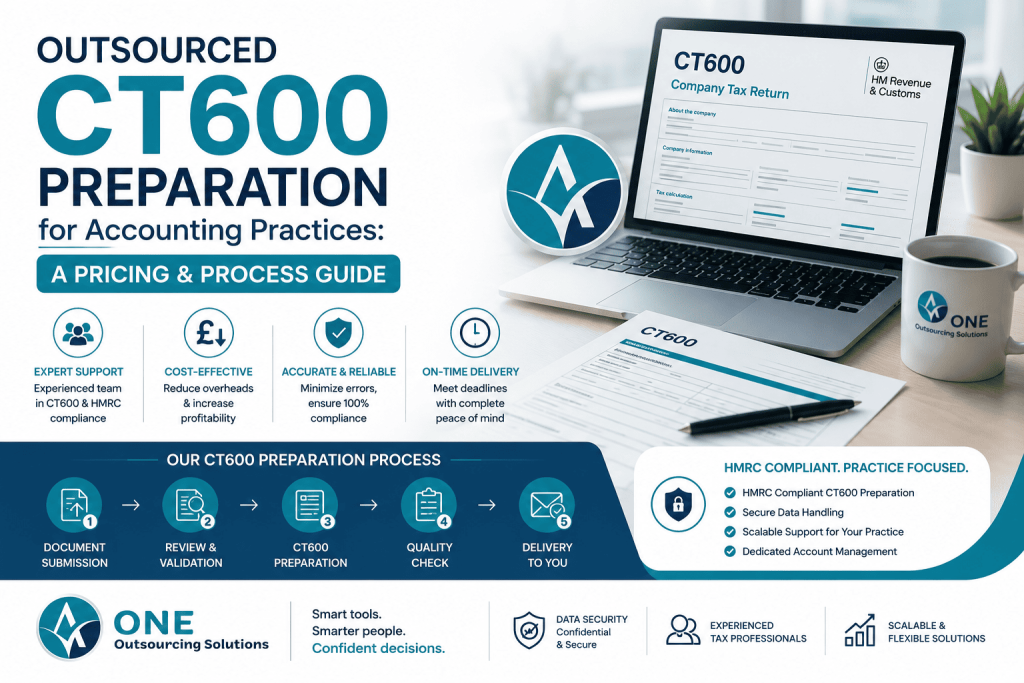




Outsourced CT600 preparation for accounting practices allows accounting firms to delegate corporation tax computations, supplementary page completion and iXBRL tagging to external specialists. Preparing CT600 returns is becoming increasingly demanding for accounting firms due to staffing challenges, rising operational costs, seasonal workload pressures and evolving compliance requirements. During peak times, accounting firms have to handle corporate tax returns with self-assessment deadlines, year-end accounts, payroll, VAT and client advisory services. According to the Advancetrack 2026 Accounting Talent Index Report, 73% of accountancy firms have turned away potential clients due to a lack of staff to deliver services. As a result, outsourced CT600 preparation has emerged as an effective way to increase work capacity without expanding internal teams.
Outsourcing does not mean losing control of client relationships or professionals’ responsibilities. A specialist outsourced service provider prepares the corporate tax computation, CT600 return and supporting documents while the accounting practice reviews, approves and authorises the final submission to HMRC.
This guide explains what CT600 preparations include, how the process works, typical pricing models and what accounting practices should consider when selecting an outsourcing partner for reliable corporation tax support.
What Is Outsourced CT600 Preparation?
Outsourced CT600 preparation is the process of hiring an external accounting & tax specialist to compute a company’s corporation tax liability and draft their corporate tax return. The outsourcing firm completes the Form CT600, handles iXBRL tagging of financial accounts, and prepares necessary supplementary schedules for submission to HMRC.
The outsourcing team generally handles tax computation, form completion, iXBRL tagging and drafting and reviewing the tax return. Rather than completing every corporation tax return internally, accounting firms delegate technical preparation work to an experienced outsourcing partner while remaining the client’s primary advisor.
For accounting firms, corporation tax outsourcing provides the flexibility to manage seasonal workloads and improve turnaround time without recruiting additional staff.
What Gets Delegated vs. What Stays In-House
A successful outsourcing agreement is built on a clear division of responsibilities. Generally, in CT600 outsourcing for accountants, preparations are delegated and responsibility for the client engagement remains on the in-house team.
Delegated Work
- Data Entry & Mapping: Data entry and reconciliation include trial balance mapping, categorising expenses, and depreciation schedule updates.
- Tax Computations: Calculating corporation tax liability, adjusting for disallowed expenses, and updating capital allowances.
- Drafting the CT600: Completing the main CT600 form and supplementary pages (e.g., CT600L for R&D tax credits).
- iXBRL Tagging: Formatting and tagging statutory accounts.
- Query Generation: Compiling a list of missing documents or anomalies for your internal team to address.
In-House Responsibilities
- Client Relationship: Gathering source documents from the client, answering their questions, and delivering tax planning advice.
- Final Review & Risk Assessment: Checking computations, assessing commercial logic, and ensuring proper application of reliefs.
- Addressing Queries: Reviewing the outsourced provider’s open-item list and contacting the client for missing information.
- HMRC Submission: Giving the final sign-off and authorising the submission directly via your own tax software.
Who This Is For
Outsourced corporate tax return preparation is suitable for accounting firms of all sizes, but it delivers particular value for firms experiencing capacity constraints during peak time. Generally, corporation tax outsourcing is for:
- Sole practitioners managing a growing portfolio of limited company clients.
- Small and medium-sized accounting firms facing seasonal workload spikes.
- Accounting firms with multiple partners looking to improve efficiency without increasing staffing costs.
- Accounting firms that want to focus more on advisory services while experienced tax professionals complete routine compliance work.
What’s Included in the Service
Corporation tax preparation services for accounting firms generally have four or five kinds of tasks assigned to a corporation tax outsourcing firm. Let’s have a detailed look at those services.
CT600 and HMRC Supplementary Pages
A typical engagement covers preparation of the main CT600 form along with common supplementary pages: CT600A for loans to participators, CT600L for research & development and creative industry reliefs and CT600C for group relief claims, depending on what the client’s circumstances require.
iXBRL-Formatted Accounts for HMRC and Companies House
Statutory accounts and tax computations in iXBRL format; HMRC requires corporation tax returns to include iXBRL-tagged accounts and computations. Depending on the filing method, the same accounts may also be submitted to Companies House.
Capital Allowances and Reliefs Review
A competent corporation tax outsourcing provider reviews the accounts for eligible capital allowances, including the annual investment allowance, and flags other reliefs the client may be entitled to before the return is finalised rather than after.
Partner-Ready Working Papers
In outsourced CT600 preparation services, partner-ready working papers are an output which is a reviewable draft with supporting working papers, not a filed return. The accounting firm reviews it, raises queries and gives a final decision. The service provider’s job is to make that review as fast and smooth as possible.
How Pricing Typically Works
Outsourced tax return pricing is not one size fits all, but it does not need to be a mystery either. An outsourced CT600 is usually priced per return or on a retainer basis, with complexity and turnaround time as the main variables, and it is a must for any CT600 outsourcing for accountants to be transparent about both.
Per-Return Flat Fee (GBP)
For firms dipping a toe in outsourcing, a flat fee per return is the simplest starting point. As an accounting firm, you agree to a fixed GBP price for a fixed return; just mention a small limited company with clean bookkeeping and no unusual disclosure, and you are quoted that rate upfront with no surprise at invoice time. This model suits firms sending over a handful of returns to test the quality, turnaround time and communication before scaling up. Typical flat fees sit within a defined range depending on the entity type (sole practitioner, partnership or limited company) and are quoted per return rather than per hour, so you can always know the cost before work begins.
Volume or Retainer Pricing
Once a firm is confident in the process, most move to a volume-based or retained arrangement. Here, you commit to a set number of returns across the tax season or a rolling monthly volume in exchange for a discounted per-return GBP rate. This is where the real savings show up, particularly for firms handling hundreds of returns a year. Retainers can also smooth cash flow and staffing on both sides since the outsourcing partner can plan capacity around your committed volume rather than reacting to ad hoc requests.
| Pricing model | Best for | How it works |
| Per-return flat fee | Firms testing a small, straightforward batch | Quoted in GBP per return, no ongoing commitment |
| Volume or retainer pricing | Firms committing to a set volume across the season | Discounted per-return GBP rate in exchange for guaranteed volume |
What Affects the Price
Not every return costs the same to prepare, and pricing should reflect that. Three factors typically drive the final quote:
- Complexity: Group relief calculations, R&D tax credit claims or multiple HMRC supplementary pages (property, foreign income, capital gains) all add preparation time.
- Turnaround Time: Standard timelines cost less than expedited or same-week requests.
- Accounting Period Length: Non-standard periods (shortened, extended, or first-year accounts) require extra reconciliation work.
Transparent corporation tax preparation services for accounting firms will walk through these variables before quoting, not after.
Need Support With CT600 Preparation?
Outsource CT600 preparation, tax computations and iXBRL tagging to help manage busy periods while your practice retains review and final sign-off.
The CT600 Filing Process, Step by Step
Outsourced CT600 preparation follows a simple five-step cycle moving from scoping through to filing, with the practice reviewing and approving every return before it reaches HMRC. Here is how CT600 outsourcing for accountants typically works.
Step 1 — Scoping
The engagement by agreeing which return types to begin with. Starting with straightforward CT600s is standard practice; more complex cases involving group relief or R&D claims tend to come later, once the working relationship is established.
Step 2 — Document Handoff (UTR, Companies House Details)
The practice sends over everything that the corporation tax outsourcing provider needs to prepare an accurate draft: client accounts, last year’s return, the corporation tax UTR, Companies House registration number, accounting period dates and any documentation relevant to the reliefs being claimed. A clear, consistent checklist at this stage avoids delay further down the line.
Step 3 — Preparation and Draft
The provider prepares the tax computation and formats the accounts in iXBRL, then returns a working draft to the practice. This is a draft for review, not a submission-ready return; nothing goes to HMRC at this stage.
Step 4 — Review and Sign-Off
The practice reviews the draft in full, raises any queries with the provider and approves the final figures. This is the step where formal professional requests rest with the practice under its own professional indemnity cover, regardless of who prepared the underlying computations.
Step 5 — Filing With HMRC
Once the practice has signed off, the return is filed with HMRC. Depending on how the engagement is structured, filing is handled either by the accounting firm itself or by the outsourcing partner on behalf of the accounting firm.
Key HMRC Deadlines Your Provider Should Already Be Tracking
Corporation tax has two separate deadlines, a penalty structure that’s changing in 2026 and a distinct payment rule for larger companies. A provider who tracks both of them without being prompted is a good sign they know this area properly.
HMRC Filing vs. Payment Deadlines
The CTC600 filing deadlines fall 12 months after the end of the accounting period. The payment deadline is earlier and separate, 9 months and 1 day after the period ends. These two dates get confused often enough that it is worth starting plainly and confirming your provider builds both into their internal tracking rather than treating them as a single deadline.
The April 2026 HMRC Penalty Structure
HMRC’s penalty regime is changing for returns due on or after April 1, 2026. Any provider you are evaluating should already be updated and able to explain clearly how it affects client filing under the new rule, not just the old date filing penalty framework. If a corporation tax outsourcing firm can’t speak to this confidently, it is a reasonable signal their process hasn’t kept pace with the current HMRC guidance.
Quarterly Instalments for Large Companies
Companies with profits over 1.5 million GBP don’t pay corporation tax in one lump sum; they pay in quarterly instalments throughout the accounting period. It is a detail that only comes up for larger clients, but an outsourcing firm that raises it unprompted demonstrates the kind of specialist depth that matters once your practice starts handling more complex returns.
What to Check Before Choosing a Provider
Not all corporation tax preparation services for accounting firms operate with the same standard. Before signing an agreement, it’s worth checking where the work actually happens, how service providers handle their busiest month, how client data is protected or whether white-label CT600 filing is genuinely on offer.
UK-Based vs. Offshore Delivery
Ask directly whether corporate tax return preparation is done onshore or offshore. It’s not just a location detail; it has real implications for how client data is handled under UK GDPR (General Data Protection Regulation) and for confidentiality obligations your practice owes its clients. Get a straight answer before you commit, not after.
Turnaround Time During Peak Season
A general service level agreement on a website doesn’t tell you much. Ask your outsourcing partner specifically about January capacity, as in this month, CT600 directly collides with self-assessment return filing, which tests a corporation tax outsourcing firm’s capacity. As per the Advancetrack Accounting Talent Index 2026 report, in the UK, 20.5% of accounting firms outsourced or offshored certain accounting tasks, which increases the burden on already burdened outsourcing firms during the peak season. A service provider’s answer to this question, in detail, says more about reliability than any marketing claim.
Data Security and UK GDPR Confidentiality
Ask how client data is encrypted, who has access to it internally and how it’s handled end-to-end from the moment documents are shared to the moment documents are handed over to final deletion under UK data protection law. Vague assurances aren’t enough; look for specifics.
White-Label / Client-Facing Presentation
Confirm the work is fully white-labelled. Your client should never need to know a third party was involved in preparing their return; the relationship and the credit for the work stay with your practice, not the provider.
Is Outsourced CT600 Preparation Right for Your Practice?
If seasonal spikes in straightforward CT600 volume are stretching your team thin, outsourced CT600 preparation is worth trialling on a small batch before scaling up; your practice keeps full review and sign-off throughout. We offer a free trial batch or capacity audit to help you see how it fits before committing further. Still weighing up whether outsourcing tax work makes sense at all? Our corporate tax outsourcing planning guide covers that decision in more depth, or explore our tax return services page to see the full scope of what we offer.
FAQs
Q1: How much does outsourced CT600 preparation cost in the UK?
The cost of outsourced CT600 preparation varies because of the return complexity and turnaround time. Generally, service providers charge a fixed fee per return or offer discounted volume pricing.
Q2: Can I outsource CT600 preparation and still stay HMRC-compliant?
Yes, you can outsource your CT600 preparations and still stay HMRC-compliant, because outsourcing accounting firms just prepare the return, while you, as an accounting firm, just review, approve and submit it to the HMRC.
Q3: What’s the difference between the CT600 filing deadline and the corporation tax payment deadline?
The CT600 is due 12 months after the accounting period ends; on the other hand, corporation tax is usually payable after 9 months and 1 day after the period ends.
Q4: Is outsourced CT600 preparation safe for client data under UK GDPR?
Yes, outsourced CT600 preparation is safe for client data under UK GDPR, provided you choose an outsourcing firm with secure systems and a UK GDPR-compliant data handling process.
Q5: Do accounting firms still need to file a CT600 for a dormant company?
It depends on the HMRC; if the HMRC requires one, then an accounting firm still needs to file a CT600 for a dormant company; otherwise, there is no need to file a CT600.
Q6: What documents are required for CT600 preparation?
Generally, statutory accounts, previous year’s CT600, UTR, Companies House details, accounting period details and supporting tax documents.
Q7: Who is responsible for submitting the CT600 return to HMRC?
The accounting firm remains responsible for the final submission unless filing has been specifically delegated to the outsourcing service provider.
Q8: What are the CT600 filing deadlines in the UK?
The CT600 must normally be filed within 12 months of the end of the accounting period.